The violations SNHD cites most, and the 10-minute fixes
The single most common violation in Las Vegas restaurants is cold food held above 41°F. It isn't a mystery, and neither are the rest: SNHD published exactly what its inspectors find most often, and almost every item on the list has a fix you can put in place before the lunch rush.
Published August 24, 2026. All percentages below come from SNHD's 2021 Risk Factor Study, in which district staff observed real Las Vegas restaurants in operation.
-
65.7%
of restaurants observed were out of compliance on cold holding, the most-cited item in the study.
The cold holding fix -
92.3%
of observed attempts to cool food at room temperature failed. Cooling on the counter almost never works.
The cooling fix -
41°F
is the number behind more demerits than any other. Cold food at 41°F or below, every unit, every shift.
Why 41°F matters
When I did this work as an inspector, I saw the same handful of violations in kitchen after kitchen. Not because owners didn't care, but because nobody had ever explained the why behind the rule or shown them a fix that survives a Friday night. So here are the five, in order of how often SNHD's study found them, each with what it is, why SNHD cares, and a fix you can make in about ten minutes.
1. Cold holding above 41°F (65.7% out of compliance)
What it is
Any food that needs refrigeration (meats, cut produce, dairy, cooked rice, sauces with protein) sitting warmer than 41°F: an overloaded cold table, a walk-in door that never quite closes, a lowboy that runs warm on hot afternoons.
Why SNHD cares
Between 41°F and 135°F, the bacteria that cause foodborne illness multiply fastest; some can double in around twenty minutes. Cold holding isn't paperwork. It's the wall between your walk-in and a sick customer, which is why it carries serious demerits when it fails.
The 10-minute fix
Take a probe thermometer and check every cold unit and cold table right now, food temperature, not the dial. Calibrate the thermometer first in a cup of ice water (it should read 32°F). Anything above 41°F gets attention today: fill inserts only to the fill line, keep lids on through the slow hours, and if a unit can't hold temperature, get it serviced before the inspector finds it for you. Then make the mid-shift temperature check a named person's job, every shift.
2. Protection from contamination (50% out of compliance)
What it is
Food left open to anything that can fall into it or touch it: raw chicken stored above the salad greens, uncovered containers in the walk-in, the same cutting board going from raw beef to cooked brisket, scoops resting inside the product.
Why SNHD cares
Cooking kills the bacteria in raw meat. Nothing kills what drips from raw meat onto food that's already cooked or will be served raw. Cross-contamination is how a perfectly cooked dish still makes someone sick, so inspectors read your storage shelves like a map of what could touch what.
The 10-minute fix
Reset the walk-in, top to bottom: ready-to-eat food on top, then whole cuts, then ground meats, then poultry on the bottom shelf. The order follows cook temperature, so a drip can never land on something that won't be cooked hotter than its source. Cover and label everything, and give raw proteins their own cutting boards. Ten minutes of shelf moving, and half this category disappears.
3. Food-contact surfaces not clean and sanitized (39.6%)
What it is
Cutting boards, prep tables, slicers, and knives that get wiped but not sanitized, sanitizer buckets that are really just gray water, a dish machine that isn't dispensing sanitizer, cloths left on the counter between uses.
Why SNHD cares
A surface that looks clean can still carry everything the last product left on it. Sanitizer at the right concentration is what actually breaks the chain between one food and the next; a dirty cloth just moves the problem around the kitchen.
The 10-minute fix
Set up fresh sanitizer buckets at every station and check them with test strips (chlorine at 50–100 ppm, or quat at your label's stated range). Run a test strip through the dish machine's final rinse too. Put a strip container at the dish pit and make "check and change the buckets" a scheduled task, every four hours during service, not a when-someone-remembers task. Cloths live in the bucket, not on the board.
4. Handwashing: when it's required (36.6%) and how it's done (31.3%)
What it is
SNHD's study found the crew skipping washes at the moments that matter (after handling raw product, after touching a phone or a face, before putting on gloves) 36.6% of the time, and washing with poor technique (too short, no soap, no paper towel) 31.3% of the time. Often the real culprit is a handwashing sink being used as a dump sink, or blocked by a cutting board.
Why SNHD cares
Hands are the most-used tool in the kitchen and the most common route for bacteria and viruses to reach food. Gloves don't change that: contaminated hands going into gloves means contaminated gloves. This is why inspectors watch hands more closely than almost anything else in the room.
The 10-minute fix
Walk to every handwashing sink and clear it: nothing stored in it, nothing blocking it, stocked with soap and paper towels. Then spend five minutes at pre-shift on the trigger moments: after raw proteins, after the phone, after the trash, before fresh gloves, twenty seconds with soap. People follow the rule when they understand it's about what their hands carry, not about being watched.
5. Cooling cooked food (ambient cooling failed in 92.3% of observed cases)
What it is
Yesterday's rice, beans, soup, or roasted meats cooled too slowly: a deep, covered container moved straight into the walk-in, or a pot left to cool on the counter. In SNHD's study, cooked-food cooling was out of compliance 53.5% of the time overall, and when staff tried to cool food at room temperature first, it failed in 92.3% of the observed cases. That number is worth sitting with: counter cooling essentially never passes.
Why SNHD cares
Cooling drags food down through the whole danger zone, and the middle of a deep container stays warm for hours after the surface feels cold. The standard (from the FDA Food Code, adopted in SNHD's regulations) is 135°F to 70°F within 2 hours, then to 41°F within the next 4. Miss the window and bacteria have had their best growing conditions of the day, in food that will be reheated and served tomorrow.
The 10-minute fix
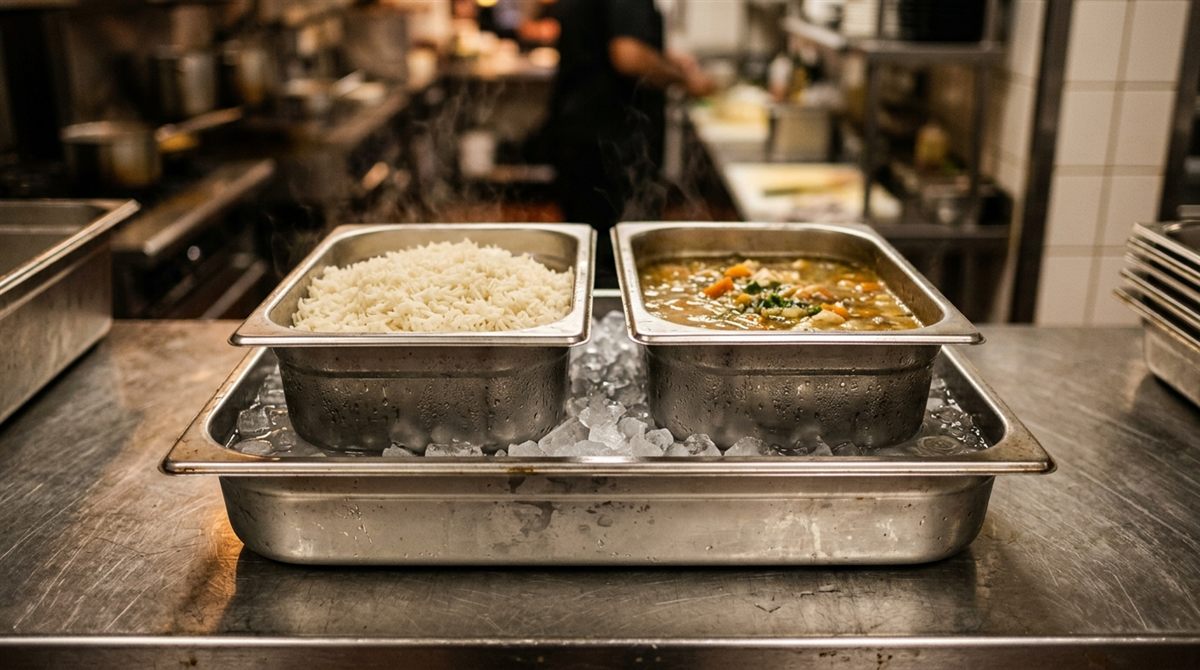
Change the container, not the effort: shallow metal pans, product no more than two inches deep, uncovered or loosely covered in the walk-in until it hits 41°F. For liquids, an ice paddle or an ice bath before panning. Label each pan with the time it started cooling, and have someone verify 70°F at the two-hour mark with a probe. The whole system costs a stack of shallow pans and a roll of tape.
Why these five, and what they have in common
These aren't random nitpicks. They're the risk factors that actually cause foodborne illness, which is why SNHD studied them and why they carry the demerits they do. Notice what they share: not one of them is fixed by scrubbing harder the night before an inspection. Every one is a small habit, run every shift, by people who understand why it matters. That's the difference between a kitchen that passes when the inspector happens to come and a kitchen that's simply always ready.
And if the inspection already went badly, the same five fixes are where recovery starts: I've written out exactly what happens after a failed SNHD inspection, including the 15-business-day clock and a day-by-day plan.
Want eyes on your kitchen before SNHD's?
A mock inspection is these five categories, and everything else on the inspector's list, checked in your kitchen the way SNHD checks it: scored on the same demerit scale, with a projected grade. Within 48 hours you get a written report: every item I found, why it matters, and exactly how to fix it, in plain language your staff can follow. $495, and it never touches your real grade. It's independent, educational, and yours alone.
See how a mock inspection works
I personally reply to every message within 2 business hours, Monday to Saturday, 8am to 6pm.
Let's make your food safety program stronger, simpler, and more effective.
Free, no pressure, at your restaurant. If you don't need help, I'll tell you.